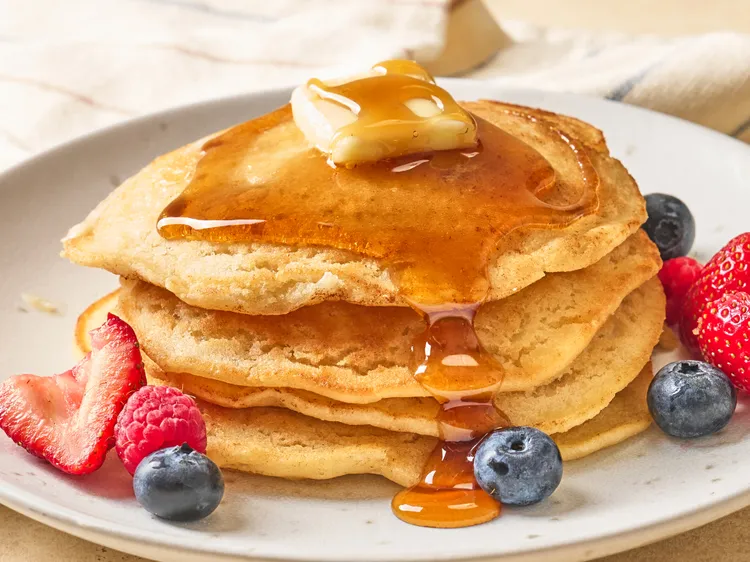
The Secret to the Loftiest Stack: Fluffy Mayo Pancakes
There is a distinct joy in a towering stack of golden-brown pancakes on a quiet morning. We look for specific traits in the perfect pancake: a delicate, lacy crispness at the very edge, a uniform golden hue across the surface, and an interior so tender and lofty that it yields effortlessly to the side of a fork.
While buttermilk has long been heralded as the standard texturizing agent for breakfast batter, there is an unconventional pantry staple that yields an even more exceptional texture: mayonnaise.
Though adding mayonnaise to a sweet breakfast batter might sound surprising at first, it relies on fundamental culinary science. Mayonnaise is simply a stable emulsion of egg yolks, oil, and a touch of acid (usually lemon juice or vinegar). When whisked into a pancake batter, these components work together to create an incredibly tender crumb. The oil coats the flour molecules, slowing down gluten development to keep the pancakes tender rather than chewy. Meanwhile, the residual acidity interacts with your leavening agents, creating a dramatic rise in the skillet.
The result is a remarkably tall, light, and airy pancake with absolutely no lingering mayonnaise flavor—just a rich, classic buttermilk-style taste profiles.
Ingredients
For the best results, measure your dry ingredients using the spoon-and-level method rather than scooping directly from the bag, which can compact the flour and lead to heavy pancakes.
For the Pancake Batter
-
2 cups all-purpose flour
-
3 tablespoons granulated sugar
-
2 teaspoons baking powder
-
1 teaspoon baking soda
-
1/2 teaspoon fine sea salt
-
1 1/2 cups whole milk (or buttermilk for extra tang)
-
1/3 cup high-quality real mayonnaise (avoid fat-free variety or salad dresssing spread)
-
2 large eggs, room temperature
-
1 teaspoon pure vanilla extract
For the Pan
-
1–2 tablespoons unsalted butter or neutral oil (such as canola or grapeseed)
Step-by-Step Instructions
1. Whisk the Dry Ingredients
In a large mixing bowl, combine the all-purpose flour, granulated sugar, baking powder, baking soda, and fine sea salt. Whisk vigorously for about 30 seconds to distribute the leavening agents evenly throughout the flour and aerate the mixture.
2. Emulsify the Wet Ingredients
In a separate medium bowl, add the mayonnaise. Slowly pour in a splash of the whole milk, whisking constantly until the mayonnaise smoothly thins out without clotting. Whisk in the remaining milk, followed by the room-temperature eggs and vanilla extract. Whisk until the liquid is entirely uniform and smooth.
3. Combine to Form the Batter
Pour the wet ingredients into the center of the dry ingredient bowl. Using a rubber spatula, gently fold the mixtures together. Stop mixing just as the flour disappears.
Chef’s Note: Small lumps are entirely fine and encouraged. Over-mixing agitates the gluten in the flour, which will make your pancakes tough and flat instead of thick and airy. Let the batter rest at room temperature for 10 minutes; you will notice small bubbles beginning to form on the surface as the leavening agents activate.
4. Preheat the Skillet
Place a large nonstick skillet or cast-iron griddle over medium heat. Allow the pan to heat thoroughly for 3 to 4 minutes. Test the heat by dropping a tiny speck of water onto the surface—it should sizzle and evaporate instantly. Lightly coat the pan with a thin layer of unsalted butter or neutral oil, wiping away any excess with a paper towel.
5. Cook Until Golden
Ladle 1/3 cup of batter onto the hot skillet for each pancake, leaving ample space between them. Cook undisturbed for 3 to 4 minutes. Look for visual cues: the edges will begin to look matte and set, and bubbles will rise to the surface and pop, leaving small, open holes.
6. Flip and Finish
Slide a wide spatula underneath the pancake and flip it in one quick, confident motion. Cook the second side for another 2 to 3 minutes, or until the bottom is beautifully golden-brown and the center of the pancake springs back gently when pressed. Transfer to a warm plate and repeat with the remaining batter.
Expert Tips & Variations
Professional Cooking Tips
-
The Temperature Sweet Spot: If your pancakes are browning too fast before rising fully, lower the heat to medium-low. Skillets hold onto residual heat, so you may need to adjust your stovetop dial slightly as you work through the batches.
-
Wipe the Pan: Leftover butter in the pan can burn between batches. Quickly wipe the skillet clean with a dry paper towel and apply a fresh, thin layer of fat before pouring your next round of batter.
Ingredient Substitutions & Dietary Variations
-
Gluten-Free Option: You can replace the all-purpose flour with a high-quality 1-to-1 gluten-free baking blend that contains xanthan gum. Allow the gluten-free batter to rest for 15 minutes before cooking to help the alternative grains absorb the moisture fully.
-
Dairy-Free Alternative: Use an equal amount of unsweetened almond milk, oat milk, or soy milk in place of the whole milk. Ensure your chosen mayonnaise brand is dairy-free (most traditional formulas naturally are, as they are egg-and-oil-based).
-
Lighter Option: If you prefer to reduce the fat slightly, you can substitute low-fat mayonnaise, though standard real mayonnaise delivers the absolute softest, cloud-like interior crumb structure.
| Ingredient Variation | Role in Batter | Texture Outcome |
| Traditional Whole Milk | Provides balanced hydration and fat | Classic tender, soft interior crumb |
| Buttermilk | Introduces extra acid | Thicker batter with a more pronounced tang |
| Oat Milk (Dairy-Free) | Offers natural sweetness | Slightly speedier surface browning |
Serving Suggestions
To appreciate their exceptional loft, serve these pancakes fresh and hot directly from the griddle.
Flavor and Texture Pairings
Pair the pillowy softness of these pancakes with a variety of textures:
-
The Classics: A generous pat of softened, salted butter melting over the top, paired with warm, pure Grade A maple syrup.
-
Fresh and Bright: A handful of tart, fresh raspberries, blackberries, or sliced strawberries to balance the rich texture of the stack.
-
Decadent Additions: A spoonful of lightly sweetened creme fraiche or whipped cream, a dusting of powdered sugar, or a scatter of toasted sliced almonds for a satisfying crunch.
Storage & Make-Ahead Notes
Pancakes are best enjoyed fresh, but they store remarkably well for quick weekday breakfasts.
Refrigeration & Freezing
-
To Refrigerate: Allow leftover pancakes to cool completely to room temperature on a wire rack to prevent dampness. Store them in an airtight container or a zip-top bag in the refrigerator for up to 3 days.
-
To Freeze: Arrange cooled pancakes in a single layer on a parchment-lined baking sheet and freeze for 1 hour until firm. Transfer the frozen pancakes into a heavy-duty freezer bag, separating layers with squares of parchment paper. They will keep beautifully for up to 2 months.
Reheating Instructions
Avoid the microwave if you want to keep the delicate edges crisp. Instead, use one of these preferred kitchen methods:
-
The Oven Method: Preheat your oven to 350°F. Arrange the pancakes in a single layer on a baking sheet, cover tightly with aluminum foil to trap moisture, and heat for 6 to 8 minutes until heated through.
-
The Toaster Method: Pop individual refrigerated or frozen pancakes directly into a standard toaster on a medium setting. This quickly revives the light crispness of the outer crust while keeping the interior fluffy.
Nutrition Information
The values provided below are realistic estimates based on a single pancake when the recipe yields 8 individual servings.
-
Calories: 210 kcal
-
Protein: 5g
-
Fat: 9g
-
Saturated Fat: 2.5g
-
Carbohydrates: 27g
-
Fiber: 1g
-
Sugar: 6g
-
Sodium: 280mg