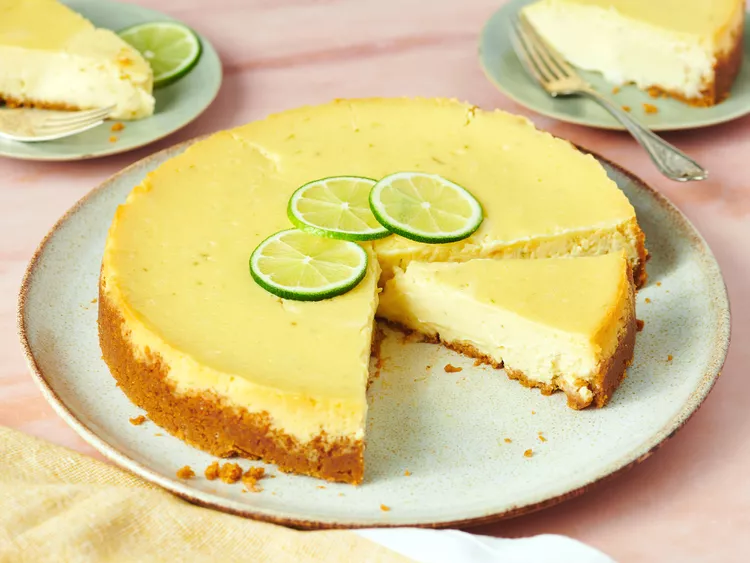
The Definitive Key Lime Cheesecake: A Study in Culinary Balance and Precision
In the hierarchy of contemporary desserts, the Key Lime Cheesecake stands as a sophisticated evolution of the classic Floridian custard pie. While the traditional pie relies on a condensed milk base, the cheesecake variant utilizes the structural integrity of lactic acid-set cream cheese to provide a dense, velvety canvas for the high-tonality acidity of the Key lime.
Achieving a professional-grade result requires more than a mere assembly of ingredients; it demands an understanding of the chemical reactions between citrus acids and dairy proteins, as well as meticulous thermal management. This guide outlines the formal procedure for executing a world-class Key lime cheesecake characterized by a crack-free surface, a buttery macadamia-reinforced crust, and a perfectly calibrated flavor profile.
Ingredients
The following specifications are designed for a standard 9-inch springform pan. For optimal emulsion, all dairy and egg components must be brought to an ambient temperature of approximately 68°F (20°C) before processing.
The Crust
-
1 ½ cups Graham cracker crumbs (finely pulsed)1
-
½ cup Toasted macadamia nuts (finely chopped)
-
3 tbsp Superfine granulated sugar
-
6 tbsp Unsalted butter (high-fat European style preferred, melted)2
-
¼ tsp Fine sea salt
The Filling
-
32 oz Full-fat block cream cheese (four 8-oz packages)
-
1 ¼ cups Granulated sugar
-
1 tbsp Cornstarch (sifted)3
-
1 cup Full-fat sour cream
-
¾ cup Freshly squeezed Key lime juice (approx. 20–25 Key limes)
-
1 tbsp Key lime zest (finely grated)4
-
2 tsp Pure Madagascar vanilla extract5
-
4 large Eggs6
The Garnish (Optional)
-
1 cup Heavy cream (chilled)
-
2 tbsp Confectioners’ sugar
-
Thinly sliced Key lime wheels
Technical Instructions
1. Crust Preparation and Par-Baking
Preheat a convection oven to 350°F (177°C). In a medium mixing bowl, combine the graham cracker crumbs, finely chopped macadamia nuts, sugar, and salt. Gradually incorporate the melted butter until the mixture achieves the consistency of wet sand.
Press the mixture firmly into the bottom and 1 inch up the sides of the springform pan. Utilize a flat-bottomed measuring cup to ensure an even, compacted distribution. Bake for 10–12 minutes until the crust is fragrant and slightly darkened. Remove from heat and allow to cool completely.
2. Filling Emulsification
Reduce the oven temperature to 325°F (163°C). In a stand mixer fitted with the paddle attachment, combine the softened cream cheese, sugar, and cornstarch. Mix on low speed for approximately 3–4 minutes.
Professional Note: Low-speed mixing is critical. High-speed aeration introduces air bubbles that expand during baking and contract during cooling, which is the primary cause of surface fractures.
Incorporate the sour cream, Key lime juice, zest, and vanilla extract.7 Continue mixing on low until the batter is homogenous, scraping the sides of the bowl twice to ensure no unblended cream cheese remains.
3. Egg Incorporation
Whisk the eggs lightly in a separate vessel. With the mixer on the lowest setting, pour the eggs into the batter in a steady stream. Mix only until the yellow streaks are no longer visible. Over-mixing at this stage will compromise the dense, creamy texture of the final product.
4. The Water Bath (Bain-Marie)
To ensure gentle, even heat distribution, the cheesecake must be baked in a water bath.8 Wrap the exterior of the cooled springform pan in three layers of heavy-duty aluminum foil to prevent water seepage. Place the pan inside a large roasting vessel.
Pour the batter into the prepared crust. Place the roasting pan on the center rack of the oven and carefully pour boiling water into the roasting pan until it reaches halfway up the sides of the springform pan.
5. Baking and Thermal Management
Bake for 65–75 minutes. The cheesecake is technically cooked when the internal temperature reaches 150°F (66°C). Visually, the edges should be set and slightly puffed, while the center (approximately 2–3 inches) should remain “jiggly” when the pan is gently agitated.
6. The Cooling Protocol
Turn off the oven and prop the door open slightly. Allow the cheesecake to remain in the water bath inside the oven for one hour. This gradual reduction in temperature allows the protein structure to set slowly.
After one hour, remove the pan from the water bath, discard the foil, and cool to room temperature on a wire rack. Cover the pan loosely and refrigerate for a minimum of 12 hours prior to slicing.
Expert Tips and Variations
-
Citrus Selection: If fresh Key limes are unavailable, a mixture of equal parts fresh Persian lime juice and fresh lemon juice provides a suitable approximation of the Key lime’s unique acidity.
-
Structural Integrity: The inclusion of cornstarch provides a “cushion” for the egg proteins, making them less likely to over-coagulate in the presence of the lime’s citric acid.
-
The Perfect Slice: For professional presentation, use a thin knife dipped in hot water and wiped dry between every cut.
Ingredient Substitution Table
| Ingredient | Substitution | Effect |
| Macadamia Nuts | Toasted Almonds | More subtle nuttiness, firmer crunch. |
| Sour Cream | Full-fat Greek Yogurt | Slightly tarter, denser mouthfeel. |
| Graham Crackers | Biscoff/Speculoos Cookies | Adds notes of cinnamon and caramel. |
Serving and Storage
Presentation
Serve the cheesecake chilled. A lightly sweetened Chantilly cream (heavy cream whipped with confectioners’ sugar) provides a necessary lipid balance to the sharp citrus notes. Garnish with a fresh lime wheel or a dusting of zest for visual contrast.
Storage
-
Refrigeration: The cheesecake may be stored in an airtight container for up to 5 days.
-
Freezing: For long-term storage, wrap the chilled cheesecake tightly in plastic film and aluminum foil. It will maintain its quality for up to 3 months. Thaw in the refrigerator for 24 hours before service.
Nutrition Information
Per Serving (Based on 12 servings)
-
Calories: 495 kcal
-
Protein: 8g
-
Total Fat: 37g
-
Saturated Fat: 21g
-
Carbohydrates: 35g
-
Fiber: 1g
-
Sugar: 27g
-
Sodium: 320mg
Note: Nutritional values are estimated based on standard ingredient data.